
Most people working in early years will know the feeling. A resource arrives looking full of promise, only to find that in everyday use it does not quite land with the children you actually have in front of you.
That can happen for all sorts of reasons. The topic may not connect. The language level may be slightly off. The voice may feel unfamiliar. Or the resource may simply be too fixed for a room where children’s interests, confidence, and support needs can vary so much from one term to the next.
This is often where talking resources fall short. Many are tied to a specific set of books, a single voice, or content that cannot easily be adapted. They may be well made, but they are not always flexible enough for day-to-day nursery practice.
When one voice does not fit every child
In a real setting, one child may happily chat away at home but say very little once they come through the nursery door. Another may be upset at drop-off and need time to settle. Another may cope well most of the morning, then struggle when the room becomes noisy or the routine changes.
That is the reality many practitioners are working with. Staff are trying to support Communication and Language, emotional security, home languages, and a growing range of additional needs—often without the time to keep creating fresh resources from scratch.
Sometimes the most useful question is not, “What new scheme should we buy?” but, “How can we make the things we already use work better for this group of children?” A favourite book, a routine card, a role-play label, or a prompt in the construction area can all become more useful when they carry a familiar voice or a short piece of recorded support.
Bringing home languages into the room
For multilingual children, this can matter a great deal. Many nursery teams know the experience of hearing, “She talks all the time at home,” while seeing a much quieter child in the setting. That does not always mean a lack of understanding. Often it is about confidence, familiarity, and the cognitive effort of managing different languages in different environments.
A short greeting in a home language, a familiar story introduction, or routine words recorded by a parent can help bridge that gap, supporting the EYFS goal of Understanding the World. It tells the child that their background is welcome here, and it gives staff a organic way to reflect family life in everyday provision rather than saving it for special multi-cultural events.
In practice, that might mean adding recorded words or phrases to a book corner display, to a “My Family” board, or to labels in continuous provision so children hear familiar vocabulary while they play. These are not big operational changes, but they can make a setting feel significantly more inclusive.
Familiar voices and difficult moments
There is also something powerful about hearing the right voice at the right moment. Most early years staff will have supported children who find separation hard, especially during September intakes or after long holidays. However calm and experienced the adults in the room may be, there are times when a familiar voice from home reaches a child in a way no one else quite can.
A short recorded message, a favourite line from home, or a familiar bedtime phrase attached to a comfort object or a well-used book can sometimes help a child co-regulate and settle more quickly. It does not replace staff support, and it is not a magic fix, but it can add another layer of reassurance at moments when children need it most.
That same idea can support children who need repetition and predictability. Some children cope better when the language around routines stays consistent: first tidy up, then wash hands, then snack. A spoken prompt linked to a visual cue can help make transitions clearer, easing the anxiety that often accompanies changes in the nursery day.
A practical SEND support
This is one of the reasons an adaptable audio approach is so valuable for children with SEND and other additional needs. In many nurseries, staff are supporting children who become overwhelmed by auditory stimuli, who need instructions repeated in the exact same cadence, or who find it hard to process spoken words when a classroom is busy.
A simple recorded prompt will not remove the need for adult judgement or sensitive key-worker support. What it can do is make some parts of the day more predictable and reduce the pressure on staff to repeat the same reassurance or instruction over and over again.
There is scope to keep this very simple. A transition card, a tidy-up reminder, a calm message in the cosy corner, or a spoken prompt added to a high-interest activity may be enough to make a difference for a particular child. That kind of flexibility matters, because SEND support in early years is rarely about finding one perfect tool; it is about making small, thoughtful adjustments that fit the child and the setting.
Screen-free and easy to weave into provision
Another advantage is that this kind of audio support does not have to mean adding more screens. Many settings are understandably wary of bringing in more tablets or digital distractions that pull children away from physical manipulation and peer interaction. Screen-free audio sits more comfortably in early years environments because it works through books, labels, toys, and natural materials that are already part of the room.
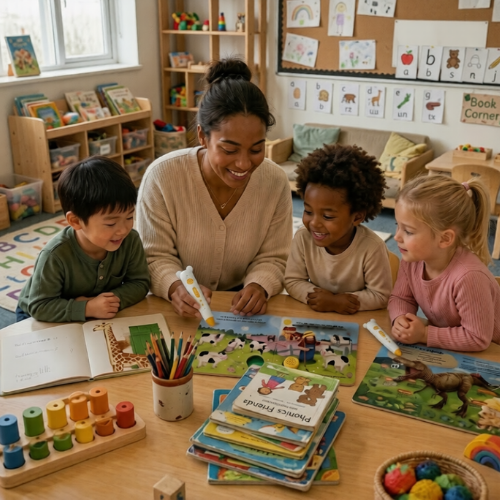
That also makes it easier to weave into continuous provision. A child in the book corner can tap to hear a repeated refrain from a story. A child in the investigation area can hear a spoken, open-ended question instead of an adult stepping in and interrupting their flow straight away. In small-group work, one child can even take the role of “reader,” tapping pictures or prompts while others listen and respond.
Used in this way, the technology stays in the background. What matters is not the novelty of the gadget, but whether it helps children engage, join in, and feel more secure in their learning environment.
Making better use of what is already there
There is also a very practical benefit here for settings trying to make tight budgets stretch. Most nurseries already have shelves of high-quality books, interactive displays, and games that children know well. They may not be brand new, but that does not mean they have lost their educational value.
Adding recorded prompts, questions, or familiar voices to existing materials is a realistic way of refreshing them without the financial and environmental cost of replacing them. It also allows staff to respond to current, fleeting child interests or the needs of a particular cohort, rather than being locked into one pre-recorded, commercial set of content.
A flexible tool, not a rigid system
This is where a dedicated recording tool paired with reusable voice stickers can become an essential part of a practitioner's toolkit. The real strength is not in the hardware itself, but in the autonomy it gives to staff and families to decide what is recorded, where it is placed, and when it needs to be updated.
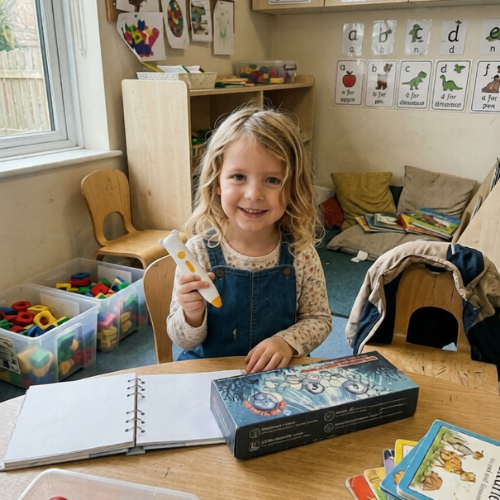
One example is the PonyABC Intelligent Recording Reading Pen used alongside Time-Capsule Voice Stickers. This system allows settings to easily overlay spoken prompts, home-language recordings, and reassuring parental voices directly onto everyday classroom materials.
In a busy nursery, tools like this are not about replacing human connection or teacher interaction. Instead, they give early years professionals one more highly adaptable, intuitive way to support communication, emotional well-being, and active participation across the entire nursery day.
Resource Link: Learn more about integrating flexible audio into your setting at ponyabc.co.uk.
